You probably saw the headlines about the FIFA World Cup coming to 11 U.S. cities next year, or the LA28 Olympics in two summers. Maybe you thought, sure, big events, big spending, but that's for the giant primes who handle stadium security and broadcast infrastructure. Not for me.
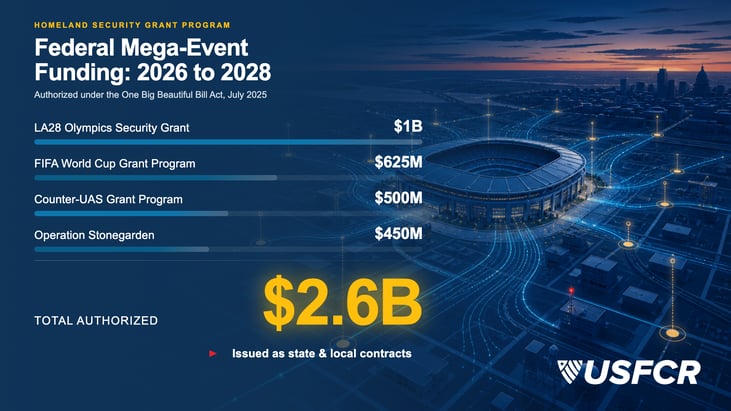
Here's what most contractors miss. The federal government has already authorized roughly 2.6 billion dollars in funding tied to these two events. That money does not get spent by FIFA or the International Olympic Committee. It flows through FEMA grants to state public safety agencies, host city committees, and local governments, who then turn around and issue actual contracts. Hotel room blocks. Pedestrian facility maintenance. Edge video compression devices. Mobile LED screens for fan watch parties. Temporary fencing. Anti-trafficking awareness campaigns. Rideshare lot management.
These are not stadium-sized contracts. They are normal small business contracts, with one unusual feature: the period of performance often runs through the end of the event. So a contract awarded in early 2026 for LA28 transportation planning has a delivery window through August 2028. You read that right. Two and a half years.
If you have been overlooking this category because you assumed the procurement window already closed, you are looking at the wrong calendar.
Where the money actually comes from
The 2.6 billion figure breaks down across four federal programs, all authorized in the One Big Beautiful Bill Act signed in July 2025. The funding sits at FEMA, available through September 2029, distributed through the Homeland Security Grant Program structure.
The FIFA World Cup Grant Program holds 625 million dollars for security and planning across the 11 U.S. host cities: Atlanta, Boston, Dallas, Houston, Kansas City, Los Angeles, Miami, the New York/New Jersey area, Philadelphia, the San Francisco Bay Area, and Seattle. The 2028 Olympics security allocation is even larger at 1 billion dollars, with the U.S. Secret Service designated as the lead agency under the National Special Security Event framework. A separate 500 million dollars funds counter-drone capabilities through the new Counter Unmanned Aircraft Systems Grant Program. Operation Stonegarden, the existing border security grant program, gets 450 million dollars on top of its baseline.
Note what these programs have in common. They are grants, not federal procurements. Which means the actual contracts get issued downstream by whoever receives the grant: state homeland security offices, host city committees, local police departments, transit authorities, parks departments. That is the layer most contractors are not searching.
What is actually getting bought
We pulled live opportunity data this week to see what was hitting the market. The categories run wider than most contractors expect.
Lodging and hotel room blocks. The Department of Homeland Security ran a sources-sought and then a combined synopsis/solicitation last fall to secure hotel rooms in all 11 FIFA host cities for White House Task Force staff. Two to ten rooms per city, 21 to 39 days each. Total small business set-aside under FAR 19.5. NAICS 721110, PSC V231. The Secret Service ran a parallel sources-sought in December for LA28 lodging, minimum 50 rooms per location, across all Olympic event venues. Same template, different event. This pattern repeats every NSSE going back two decades.
Transportation planning and operations. This is the largest category by dollar potential. The City of Oklahoma City has an active LA28 transportation planning contract, which surprised us until we remembered that softball and canoe slalom got moved to Oklahoma River Sports complex to save Los Angeles the cost of building new venues. San Bernardino County Transportation Authority has a multi-year mobility program running through December 2028. Caltrans is buying edge video compression devices and 5G modems for CCTV along Olympic route networks. Kansas City's transit authority is rolling out a new fare collection system phased to be live before FIFA matches start. North Central Texas Council of Governments has an active solicitation for a FIFA After-Action Report that includes catering for 200 to 250 participants at the post-event hotwash.
Security equipment and technology. Massachusetts State Police is buying under-vehicle monitoring systems with FIFA grant funding. The Coast Guard in Boston has an active contract for an autonomous surface patrol vessel with a counter-UAS detection suite, period of performance running for the duration of the event. Multiple Army and Air Force counter-drone industry days are open right now.
Event services and staffing. Los Angeles County is staffing parking monitors for FIFA viewing parties at Burton Chace Park. Miami is forecasting waste management and security technology purchases for a 23-day Fan Festival around Bayfront Park. The Georgia World Congress Center Authority just closed solicitations for temporary VIP structures and fencing at the Atlanta Fan Festival. Dallas bought turf application chemicals for the Cotton Bowl.
Public awareness campaigns. This one surprised us. Massachusetts has a 2 million dollar grant program for human trafficking awareness specifically tied to the FIFA visitor influx. Several other state public safety offices are running similar campaigns. NAICS 541613 and 54191. Grant-funded, so smaller awards, but consistent demand.
Civil infrastructure and beautification. Wyandotte County and Kansas City have forecasted intersection improvements for an expected 670,000 visitors. Philadelphia's airport is buying year-round videography. The City of Los Angeles is installing street banners across the city through July 2026.
The category list is not exhaustive. It is a sample of what came up in one week of searching across two procurement databases.
Why these contracts stay open longer than you expect
The 1- to 2-year open window is not a quirk. It reflects how event procurement actually works. Different categories have different timing logic.
Hotel blocks tend to move fast. Sources sought to award in two to four weeks, performance period the length of the event. If you are not ready to respond when the sources sought hits, you miss it.
Transportation and infrastructure contracts move slow. The active LA28 transportation contracts were posted in late 2025 and early 2026, with periods of performance running through December 2028. If you bid one of these and win, you have a multi-year revenue stream.
Security technology sits in between. Six to 18 months of procurement lead time, with some contracts issued 18 months out from the event. The Caltrans CCTV upgrade was posted in December 2025 for an event in July 2028.
Event operations contracts (fan festival staffing, waste, LED screens) run on short windows. Posted four to eight weeks before the event, performance period equal to the festival duration. These are the ones a small business with the right capability set can scoop up quickly.
Grant-funded public safety contracts time to the grant cycle, typically three to six months before the event.
What this means in practice: if you wait until the spring of 2026 to start looking at FIFA opportunities, you have already missed the infrastructure and transportation contracts. But the event operations layer is still wide open. And the entire LA28 procurement cycle is just getting started.
How to actually find these contracts
The honest answer is that no single search platform catches all of them. Federal opportunities live on SAM.gov. State and local opportunities live across hundreds of state procurement portals, host city RFP sites, and individual agency pages. The grant programs themselves do not appear as procurement solicitations; they appear as Notices of Funding Opportunity on Grants.gov, but the contracts they fund show up downstream under whichever agency received the grant.
A few practical things we have learned running these searches:
Search by quoted phrase, then again unquoted, and compare the results. Quoted "FIFA" and unquoted FIFA can return wildly different sets, depending on how the platform indexes title fields versus full description text. The same is true for "LA28" versus 2028 Olympics versus Olympic Games. Many of these contracts mention the event in the description body, not the title, so a title-only search misses them.
Look at the agency, not just the keyword. Once you find one FIFA contract from a Massachusetts public safety office, search every active opportunity from that office. The same pattern holds for LA County Internal Services, North Central Texas Council of Governments, and the Georgia World Congress Center Authority. These agencies are running multiple event-related procurements in parallel.
Watch the forecasts and city council agendas. The City of Los Angeles has been publishing forecast items for LA28 procurement plans through 2028. The cities of Miami, Tacoma, and Kansas City are doing the same. Forecasts give you 6 to 12 months of warning before a solicitation drops.
Check the period of performance, not the deadline. A solicitation with a response deadline next month and a performance period running through August 2028 is very different from a one-shot delivery contract. Multi-year periods of performance are a tell that the contract is event-related even when the title doesn't say so.
Pay attention to set-asides. The DHS FIFA lodging contract was a Total Small Business Set-Aside. The Secret Service Olympics lodging contract is similarly structured. The LA28 Organizing Committee has stated a goal of 25 percent of spending going to small businesses, with a stated preference for businesses inside the City of Los Angeles. If you are a small business in Southern California, you have a structural advantage you are probably not using.
What to do this week
If you have ever bid government contracts, you already know the unglamorous work that turns awareness into revenue: get the registration current, get the right NAICS codes flagged, build a capabilities statement that speaks to the specific category you want to win, set up alerts for the agencies running the procurements you care about, and start watching forecast items so you have lead time on solicitations before they post.
What is different about mega-event contracting is the category breadth. You probably already have a NAICS code that fits one of the buckets above. Lodging providers, IT integrators, transportation consultants, security services, signage and printing companies, civil engineering firms, public awareness and creative agencies, waste management, equipment rentals, language services, accessibility consultants. All of these are getting bought. If your business does any of them, you have a path into this market that does not require you to be a defense prime.
The federal funding is authorized. The procurement window is open. The contracts run for years. Most of your competitors are not looking. That is the opportunity.
How USFCR Helps
USFCR has helped over 500,000 businesses position for federal contracting success. Our clients have won over 1.7 billion dollars in federal contracts. If you want help identifying which mega-event contract categories fit your business, getting your NAICS codes and registrations aligned, or setting up the search and alert structure to catch these opportunities before your competitors do, we can help.
Speak to a USFCR Registration & Contracting Specialist. Call (877) 252-2700 or visit usfcr.com.

Frequently Asked Questions
Are FIFA and LA28 contracts only available to businesses in host cities?
No. Federal procurements (DHS, Secret Service, Coast Guard, State Department) are open to qualified small businesses nationwide. State and local opportunities follow the procurement rules of the issuing agency, which vary. Some have local preference programs (the City of Los Angeles is mandating LA28 prioritize City businesses), but most state and county procurements are open to qualified bidders regardless of location.
Do I need a special certification to bid mega-event contracts?
The same set-asides that apply to other federal procurements apply here. The DHS FIFA lodging contract was a Total Small Business Set-Aside. SDVOSB, WOSB, HUBZone, and 8(a) certifications all unlock specific categories. You do not need an event-specific certification.
Are these contracts only for security and large infrastructure?
No. The category breadth is much wider than most contractors expect. Lodging, transportation, IT, signage, waste management, public awareness campaigns, event operations, accessibility services, and civil infrastructure are all active categories. The dollar amounts range from a few thousand for short-duration event services to multi-million for multi-year infrastructure programs.
How long do mega-event contract opportunities stay open?
It depends on the category. Hotel and event services contracts often have short response windows of two to six weeks. Transportation and infrastructure contracts can have long performance periods, with some LA28 contracts running through December 2028. Watch the period of performance, not just the response deadline.
What is the best way to find these contracts?
A combination of federal opportunity searches on SAM.gov, state and local opportunity searches across the relevant host city procurement portals, and forecast monitoring through city council agendas and public meeting records. Most contractors miss these because the relevant keyword (FIFA, LA28, Olympic) appears in the description body rather than the title, so title-only searches return zero results. Search platforms vary widely in how they index this content.
Verification note: Federal funding figures cited in this article reflect appropriations under the One Big Beautiful Bill Act of July 2025, distributed through the FEMA Homeland Security Grant Program structure. Specific solicitation details (deadlines, set-aside status, NAICS/PSC codes) are accurate as of the date of research and are subject to change. Confirm current solicitation status directly with the issuing agency before bidding.
Top Articles
The 17 Most Common Types of Government Contracts Explained
Writing a Winning Capabilities Statement in 2026
Understanding Federal Set-Asides


