An active SAM registration does a lot more than check a compliance box. With your UEI and CAGE code, it lets you bid on federal contracts and apply for grants, get paid electronically, compete for small business set-asides, team with prime contractors, and show up when contracting officers search for vendors. To get the most from it, renew it every year, keep your NAICS codes and business size accurate, complete your SBA Small Business Search profile, and opt into the registries that fit your business.
The FAS Catalog Platform, or FCP, is the system GSA Schedule holders use to keep their contract catalog current and compliant. It's replacing SIP and EDI-832, and GSA is moving contractors onto it in waves.
If you hold a Schedule, you'll end up on FCP. The question isn't whether. It's when, and what you should be doing until your turn comes.
GSA eLibrary is where you check who holds a GSA Schedule and what that contract covers. It's free, it's public, and it's the fastest way to find out whether a company is actually on Schedule before you do business with them.
It's also the tool most contractors misunderstand. eLibrary answers a narrow set of questions extremely well. Ask it anything outside that set and you'll come away with the wrong answer, or no answer at all.
Here's what it does, what it doesn't, and where to go for the rest.

GSA's OASIS+ contract program just got bigger. As of January 12, 2026, all six solicitations are open under continuous enrollment, and five new service domains have been added to the original eight. For professional services contractors, this is the clearest path into long-term federal work.
If you missed the earlier submission windows, the door is open again. And it's staying open.
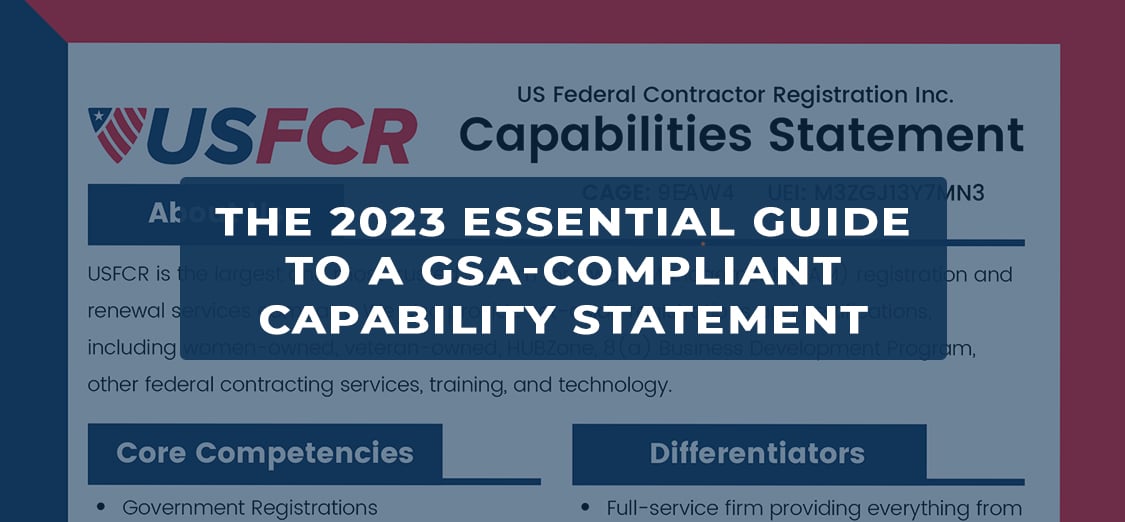
The Schedule Holder's Capability Statement: What Changes When You're on MAS
If you hold a GSA Multiple Award Schedule contract, your capability statement should not look like everyone else's.
Most guidance on capability statements is written for businesses trying to get noticed for set-aside opportunities. That advice is sound, and if you need the fundamentals — page length, core competencies, past performance, differentiators — start with our full guide to writing a capabilities statement.
This piece covers something narrower: what changes about the document once you have a Schedule contract, and why most Schedule holders never make those changes.
Why This Matters More Than It Used To
Holding a Schedule used to be its own reward. Get the award, get listed, wait for orders.
That's over. GSA's rightsizing initiative has been allowing contracts that don't produce sales to expire, and the minimum sales requirement now sits at $100,000 across your first five years and $125,000 in each option period after that. Sales performance is an explicit factor in whether your contracting officer exercises your next option.
Which means marketing your Schedule is no longer optional maintenance. It's how you keep the contract. And the capability statement is the cheapest marketing tool you own.
The Reader Is Different
This is the shift that drives everything else.
A general capability statement is usually aimed at a small business specialist doing market research — someone deciding whether enough qualified small businesses exist to justify setting an acquisition aside. They're scanning for NAICS codes and socioeconomic status.
A Schedule holder's capability statement reaches a different desk:
- Agency buyers who have already decided to purchase through Schedule and are deciding from whom
- Contracting officers doing market research before posting an eBuy RFQ
- Prime contractors assembling a team for a Schedule-based task order
- Agencies scoping a Blanket Purchase Agreement, which requires surveying available Schedule holders first
Every one of these readers has already resolved how they're buying. Your document doesn't need to sell them on the vehicle. It needs to prove you're the right holder within it.
Put Your Contract Number at the Top
Not in a "contract vehicles" line halfway down. At the top, near your company name.
For a buyer working within the Schedule, your MAS contract number is the qualifying credential. It determines whether they can buy from you at all. Making them hunt for it, or worse, look you up in eLibrary to confirm you actually hold what you claim, is friction you don't need.
Include the contract number, the period of performance, and which option period you're currently in. That last detail quietly answers a question buyers do think about: is this contractor going to still be here when the work finishes?
SINs Outrank NAICS
This is the inversion most Schedule holders miss.
On a general federal capability statement, NAICS codes are the primary identifier. On a Schedule holder's statement, Special Item Numbers come first.
The reason is simple: it's how buyers search. Agency buyers researching Schedule holders use GSA eLibrary and eBuy, and both are organized by SIN. When a contracting officer builds an eBuy RFQ, they select SINs. When they browse eLibrary for capable vendors, they filter by SIN. NAICS is secondary in that workflow.
List your awarded SINs with their plain-language titles, not just the numbers. 541611 — Management and Financial Consulting communicates to a human reader in a way that a bare number doesn't. Keep NAICS on the document, but let SINs lead.
If you were awarded SINs you don't actively pursue, consider leaving them off. A focused list reads as expertise. An exhaustive one reads as a company that took whatever it could get.
The Schedule-Specific Data Block
Beyond your standard UEI, CAGE code, and certifications, a Schedule holder's statement should carry:
- MAS contract number
- Awarded SINs with plain-language titles
- Contract period of performance and current option period
- GSA Advantage catalog status — confirm your catalog is live and current, then say so
- Any Schedule BPAs you hold, with the awarding agency
- Cooperative purchasing eligibility, if your SINs qualify. State, local, and tribal governments can buy certain categories through Schedule, and most buyers in that space don't realize it. Saying so opens a market your competitors aren't mentioning.
- Disaster purchasing eligibility, if applicable — this lets state and local entities buy from your Schedule to prepare for or recover from a major disaster
Past Performance, Adjusted
Lead with orders placed against your Schedule if you have them. A buyer evaluating you as a Schedule holder wants evidence that ordering from you through this vehicle has gone well before.
Include the ordering agency, the SIN the work fell under, dollar value, and period of performance.
If you're newly awarded and don't have Schedule order history yet, don't fake depth. Use your strongest relevant federal or commercial work and let it speak for itself. Every Schedule holder starts at zero orders, and buyers know it.
What to Cut
Legacy schedule numbers. If your statement says "GSA Schedule 70," "Schedule 84," "Schedule 00CORP," or any other pre-consolidation designation, remove it now. Those schedules were merged into the single Multiple Award Schedule beginning in 2019. A statement still using that vocabulary tells every buyer who reads it that your marketing materials haven't been touched in years — and invites the question of what else is out of date.
Long explanations of what a GSA Schedule is. Your reader already knows. Space spent explaining the vehicle is space not spent on why you're the right holder within it.
Generic differentiators. The bar is higher here, not lower. Everyone in the eBuy results holds a Schedule. "GSA Schedule holder" is not a differentiator when your competition is defined as other Schedule holders. What distinguishes you among them?
Keep It Synchronized
One failure mode is specific to Schedule holders: your capability statement and your GSA Advantage catalog drifting apart.
If your statement claims capabilities your catalog doesn't reflect, or your catalog lists items you no longer offer, a buyer who checks will find the discrepancy. Treat the two as one system. When you file a modification, update the statement in the same sitting.
Same for option periods. The date on your statement should never be older than your last contract action.
The Short Version
Contract number at the top. SINs before NAICS, with plain-language titles. Option period stated. Catalog confirmed live. Past performance built from Schedule orders where you have them. Legacy schedule numbers gone. Differentiators that separate you from other holders, not from the open market.
Your Schedule gets you into the consideration set. This document decides what happens next.

How to Price Your GSA Schedule in 2025 (Without Losing Your Profit Margin)
Pricing under a GSA Schedule isn’t just about winning bids—it’s about protecting your bottom line while staying within the rules. Your GSA rates need to be competitive, but they also need to be compliant. If you don’t understand how GSA views your pricing, you could end up with rates that are unworkable, subject to mandatory reductions, or flagged during an audit. That’s why a strong GSA pricing strategy is more than just a number—it’s a defense plan.
Winning a GSA Schedule is one of the best ways for businesses to enter federal contracting. However, startups and newer companies often face challenges due to past performance requirements. The GSA Startup Springboard Program provides an alternative path, allowing businesses to qualify using different criteria.
The General Services Administration (GSA) is a huge component of federal procurement, managing billions in government spending across contracts, technology, and real estate. Recent leadership changes at GSA could significantly shift how the agency operates, affecting everything from acquisition strategies to contractor relationships. Understanding these changes is essential for businesses looking to maintain or expand their footprint in the federal marketplace.
GSA Schedules: Your Path to Federal Contracting Success
The General Services Administration (GSA) plays a vital role in simplifying government procurement. Through GSA Schedules, also known as Federal Supply Schedules (FSS) or Multiple Award Schedules (MAS), businesses can access a streamlined pathway to sell goods and services to federal, state, and local governments. This guide provides a comprehensive overview of GSA Schedules, their benefits, eligibility requirements, and how to get started.
