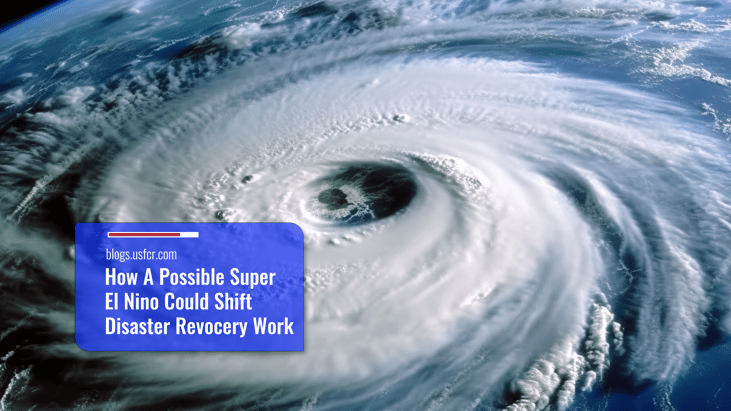
A possible super El Niño is already becoming one of the biggest weather stories of 2026.
Talk about El Niño will probably put hurricane season in the spotlight first. That focus belongs there, but contractors should also watch how the pattern could shape other disaster recovery needs later in the year.
For government contractors, the value is in watching how the weather story moves into public-sector planning. Recovery work starts taking shape when agencies and prime contractors begin identifying what may need support and which vendors are ready to provide it.
The 2026 outlook is still taking shape, and NOAA hasn’t released its official Atlantic hurricane season outlook yet, meaning early forecasts shouldn’t be treated as the final word. Contractors don’t need to chase every update, but they do need a clear way to understand what each major development could mean for readiness.
For more than 15 years, USFCR has helped contractors navigate federal readiness needs as weather events, agency priorities, and recovery demands continue to evolve. As new hurricane season and El Niño updates come out, USFCR will keep breaking them down so contractors can stay focused on the decisions that matter most.
What The El Niño Watch Actually Means
“Super El Niño” is the phrase many readers are already seeing in news coverage. Official climate sources use more measured language, but the public label still matters because it shapes how people follow the season.
As of NOAA’s April 9, 2026, Climate Prediction Center diagnostic, the El Niño–Southern Oscillation, or ENSO, was still in a neutral phase. In simple terms, the Pacific climate pattern hadn’t yet shifted into El Niño or La Niña conditions. La Niña had ended, and NOAA had issued its Final La Niña Advisory along with an El Niño Watch. That means NOAA was no longer tracking an active La Niña pattern, but conditions were favorable enough to watch for possible El Niño development.
NOAA pointed to a 61% probability of El Niño emerging during May through July. If it develops, NOAA expects it to persist through at least the end of 2026, which is why this forecast matters beyond the beginning of hurricane season.
The phrase “super El Niño” comes from the chance that this pattern could intensify later in the year. NOAA’s outlook remains more cautious, ranging from neutral conditions to a very strong El Niño by winter 2026–27. For now, that upper-end scenario carries a 1-in-4 probability.
Spring ENSO forecasts are still early, and the picture will sharpen as NOAA and other forecasters release later updates. USFCR will keep following those releases and breaking down what they may mean for contractors in the preparation phase of federal recovery work.
That guidance has even more value when contractors can connect it to real opportunity movement. USFCR’s Advanced Procurement Portal helps businesses track relevant solicitations, review award history, and stay close to the lanes that match their recovery capabilities. As the 2026 forecasts sharpen, APP gives contractors a practical way to monitor opportunity activity tied to the work they are positioned to support.
Reading The Hurricane Season Forecast Carefully
Colorado State University released its initial 2026 Atlantic hurricane season forecast on April 9, with updates expected in June, July, and August. That update schedule gives contractors several checkpoints as hurricane season approaches and the El Niño pattern becomes easier to read.
The CSU forecast includes 13 named storms, 6 hurricanes, 2 major hurricanes, and overall storm energy around 75% of average. CSU also noted a mixed Atlantic picture, with warmer waters in the western tropical Atlantic and cooler conditions farther east. Those numbers help frame the season, but they shouldn’t be treated like a map of where damage will happen.
USFCR watches this distinction closely because disaster recovery contracting doesn’t move on forecasts alone. A storm may shape early preparedness, but contracting activity gains traction when agencies can connect the impact to work that needs to be performed.
That’s what makes the forecast a useful tool for contractors. It gives the season shape without providing the whole answer. One storm in the wrong place can still create serious recovery demand, even when the broader season looks manageable on paper. The 1983 season is a powerful reminder. It produced only four named storms and one major hurricane, yet Hurricane Alicia reached the Galveston area as a Category 3 storm and caused billions in damage.
The forecast should create focus, not tunnel vision. August through October remains a key hurricane-season window, but recovery planning may continue well beyond those months if the El Niño pattern strengthens late in the year. The key strategic question is where recovery needs could build during hurricane season and across the months that follow.
Where Recovery Needs May Start to Move
A possible super El Niño can change more than the hurricane conversation. If the pattern develops and strengthens, disaster recovery planning may start moving across a wider map. For contractors, the useful question is where public systems may come under pressure and how that pressure could turn into work.
Water Pressure Could Build Across the South
El Niño typically brings wetter-than-normal conditions across the southern United States, especially during fall and winter. Florida, the Gulf Coast, and the Southeast may see more storm systems, higher flood risk, and heavier pressure on public infrastructure during the cooler months. If El Niño develops during the May through July window, that southern signal may become more noticeable late in 2026 and continue into early 2027.
For contractors, the connection is practical. More water-related pressure can affect roads, drainage, utilities, public facilities, and the infrastructure communities depend on after a disruption. That can move attention toward the businesses prepared to support repair, restoration, and recovery work when public systems are strained.
The West May Face A Different Timing Problem
The West may not feel the effects on the same schedule. Some areas could continue facing wildfire or water-stress concerns if dry summer conditions persist before El Niño’s cooler-season pattern arrives. Later in the year, El Niño has historically brought wetter winter conditions to California, Arizona, and the Southwest, while the Pacific Northwest signal is less consistent.
That timing can keep wildfire recovery and water-related work connected. A dry summer can leave behind burn scars, damaged land, and stressed water systems. Later rainfall can then create new concerns around erosion, debris movement, and repair needs in areas already carrying damage.
The Southwest Could See Both Relief & Risk
The Southwest and Four Corners region may face a more mixed picture. El Niño can enhance summer monsoon activity across parts of Arizona, New Mexico, and Colorado. More rainfall can help drought conditions, but it can also raise flash flood risk, especially near burn scars and terrain prone to debris flow.
That’s what makes this region different. The same rainfall that helps relieve dry conditions can also damage roads, block access, or destabilize areas already affected by fire. For contractors, this creates a recovery picture in which cleanup, access restoration, and site stabilization may become part of the same conversation.
A Wider Recovery Market Needs Sharper Focus
Taken together, these patterns show why a possible super El Niño should be read as more than a hurricane-season story. Disaster-related demand may move across regions as the year develops, and the contractors best positioned for that shift will be the ones using market intelligence before the work becomes obvious.
That shift can reach beyond immediate storm response. Some recovery work is tied to public infrastructure, some to environmental repair, and some to emergency support that has to be ready before urgent needs become public. USACE’s use of pre-awarded emergency contracts is one example of how recovery work can be structured before the public sees the full need.
A broader recovery environment can create more possible paths, but stronger contractors still need to know which ones deserve attention. Market research helps turn a wide field into a more realistic target list. It shows where similar work has moved before, which buyers have a history of purchasing it, and how a business should position its federal presence around the contracts that actually fit.
USFCR’s Government Contractor Accelerator helps businesses turn that research into a tailored federal strategy. GCA supports market research and federal presence positioning so contractors can align their capabilities with the agencies, opportunity types, and recovery lanes they are prepared to pursue.
For contractors, the advantage is not just seeing a wider market. It’s knowing where the business belongs inside it and making that position easier for buyers and partners to recognize.
What This Means For Contractors
A possible super El Niño should bring more discipline to hurricane season planning, not less urgency. Contractors still need to treat the season as a major readiness window while watching how El Niño-related conditions may shape recovery needs around it.
The businesses that gain the most from that planning will be the ones that know what they are built to support before the market starts moving. Disaster recovery can create a wide range of needs, but federal opportunities still reward businesses that can make their role clear quickly.
That’s why federal presence matters before urgency arrives. A contractor may have the right equipment, experience, or service capacity, but that strength has to show up in the places buyers and prime contractors use to evaluate fit. When the business is easy to understand, its capabilities have a better chance of being considered for the right work.
USFCR helps contractors build that kind of position before the market becomes crowded. If disaster recovery is part of your federal growth strategy, now’s the time to strengthen the federal presence behind it and prepare for the recovery work your business is built to win.

FAQ
What does “super El Niño” mean?
“Super El Niño” is the phrase many readers are seeing in news coverage, but official climate sources use more measured terms. NOAA’s current outlook points to a wide range of possible outcomes, including the chance of a very strong El Niño by winter 2026–27. For contractors, the label matters less than how the pattern may shape disaster recovery planning.
Why does El Niño matter for disaster recovery contractors?
El Niño can influence where weather pressure builds and when recovery needs may become more visible. For contractors, the important point is not the weather label itself. It is whether changing conditions could affect the timing, location, and type of recovery work public agencies may need to support.
Does a possible super El Niño change the importance of hurricane season?
Hurricane season remains a major readiness window. A possible super El Niño should not move attention away from it. Instead, it gives contractors another reason to watch how hurricane-season planning connects to recovery needs that may continue developing later in the year.
Should contractors focus only on hurricane-related work?
No. Hurricane season may bring disaster readiness into focus, but recovery work can also involve infrastructure repair, drainage, environmental restoration, temporary support, and other needs that follow public impact. Contractors should focus on the work they can realistically support and make that role easy to understand.
How can contractors prepare without overreacting to weather forecasts?
The best move is to build readiness around capability fit rather than one forecast. Accurate registration, clear capability presentation, focused opportunity searches, and useful past performance all help buyers and prime contractors understand where a business belongs when recovery work starts moving.
Sources
National Weather Service, Climate Prediction Center. (2026, April 9). ENSO diagnostic discussion. National Oceanic and Atmospheric Administration. https://www.cpc.ncep.noaa.gov/products/analysis_monitoring/enso_advisory/ensodisc.shtml
National Oceanic and Atmospheric Administration. (n.d.). El Niño-Southern Oscillation (ENSO). NOAA Climate.gov. https://www.climate.gov/enso
Colorado State University Tropical Cyclones, Radar, Atmospheric Modeling, and Software Team. (2026, April 9). Seasonal hurricane forecasting: Forecast for 2026 hurricane activity. Colorado State University. https://tropical.colostate.edu/forecasting.html
Klotzbach, P. J., Bell, M. M., Silvers, L. G., Lee, J., Colón Burgos, D., & Mesa, N. (2026, April 9). Extended range forecast of Atlantic seasonal hurricane activity and landfall strike probability for 2026. Colorado State University. https://tropical.colostate.edu/Forecast/2026-04.pdf
Mullane, S. (2026, April 14). A super El Niño is in the forecast. Here’s what that means for Colorado. The Colorado Sun. https://coloradosun.com/2026/04/14/colorado-super-el-nino-monsoon-summer-forecast/
U.S. Army Corps of Engineers. (n.d.). Hurricane season. https://www.usace.army.mil/Missions/Emergency-Operations/Hurricane-Season/
Lisonbee, J. (2026, March 11). New NOAA El Niño-Southern Oscillation Index supports drought early warning. Drought.gov. https://www.drought.gov/news/new-noaa-el-nino-southern-oscillation-index-supports-drought-early-warning-2026-03-11
Canon, G. (2026, April 13). Are we heading for “super El Niño” – and what could we expect? The Guardian. https://www.theguardian.com/environment/2026/apr/13/el-nino-explainer

