Quick Answer
Federal emergency response contracting is how the government buys the goods and services it needs to respond to disasters like wildfires, floods, and severe storms, often on short timelines. Because agencies have to move quickly, they turn to businesses that are already registered and prepared. For contractors, that means readiness, not a fast reaction once a disaster hits, is what makes this work accessible.
Key Takeaways
- Federal emergency response contracting covers the goods and services agencies need to respond to disasters, often on short timelines.
- Agencies buy quickly in an emergency, so they rely on contractors who are already registered and prepared.
- Readiness, not a fast reaction after a disaster begins, is what makes this work accessible.
- The same federal foundations apply: active registration, accurate profiles, and relevant capabilities.
- Emergency response work is one part of a broader federal contracting strategy, not a standalone path.
Why Readiness Comes First in Emergency Response Work
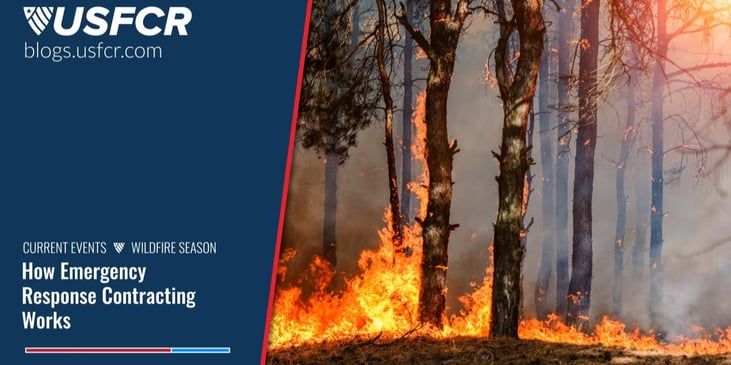
Federal emergency response contracting is how the government buys the goods and services it needs to respond to disasters, and because that buying often happens fast, it favors businesses that were already registered and prepared before the need arose. Wildfire season is a clear example of the pattern. When fires break out, agencies need equipment, logistics, cleanup, and recovery support quickly, and they turn to contractors who are ready to deliver. The work is real, but it rewards preparation rather than a scramble once an emergency is already underway.
How Agencies Buy in an Emergency
Emergency response changes how the government buys. In a typical procurement, agencies plan, post a solicitation, and run an evaluation over weeks or months. In an emergency, that timeline compresses, and agencies use faster methods to get goods and services in place quickly. Federal agencies lead the response, and depending on the disaster, state and local agencies take part as well.
What does not change is who is eligible. To be considered, a business still has to be properly registered in the federal system, with accurate records and capabilities the agency can find and verify. The speed of emergency buying is exactly why preparation matters. There is rarely time during an active response for a business to register, correct its records, and position itself from scratch. The contractors who support this work are generally the ones who were already in the system and visible before the disaster.
The Kinds of Work Involved
Emergency response contracting spans a wide range of goods and services, which is part of why businesses across many industries can be relevant to it. Common categories include equipment and supplies, transportation and logistics, temporary facilities and housing, debris removal and cleanup, construction and repair, and a range of professional and support services. Wildfire response, for instance, can involve everything from equipment and crews to logistics, site cleanup, and rebuilding once the immediate danger has passed.
The point for a contractor is to understand where your actual capabilities fit. Emergency response is not a separate business you bolt on. It is a situation in which your existing capabilities may be needed quickly, and being clear about what you can genuinely deliver, and being registered to deliver it, is what makes you useful when an agency is moving fast. Across the 500,000 businesses USFCR has guided since 2010, the ones positioned for this work treat it as an extension of what they already do well, not as a disaster-driven detour.
Getting Ready Before You Need To Be
Readiness for emergency response work is mostly the same readiness that supports any federal contracting, applied ahead of time. The foundation is an active, accurate federal registration, a profile that reflects your real capabilities, and documentation that lets an agency confirm you can do the work. From there, it helps to understand which agencies handle the kinds of disasters relevant to your region and industry, and what they typically buy.
Timing is the part contractors most often get wrong. The instinct is to look into emergency response work when a disaster is in the news, which is the moment there is the least time to get ready. The contractors who are genuinely available to help are the ones who built that readiness during ordinary conditions. If emergency response work fits your business, the time to prepare is now, while there is no emergency, so you are positioned to deliver when one arrives.

FAQ
What is federal emergency response contracting?
It is the way the federal government buys the goods and services it needs to respond to disasters such as wildfires, floods, and severe storms. Because the response often has to happen quickly, agencies use faster buying methods and rely on businesses that are already registered and prepared to deliver.
Do I need to be registered to do emergency response work?
Yes. Eligibility for federal emergency response work runs through the same foundation as other federal contracting, starting with an active and accurate federal registration. There is rarely time to register during an active emergency, which is why preparing in advance is what makes this work accessible.
What kinds of businesses support emergency response?
A wide range, because the work spans many categories, including equipment and supplies, transportation and logistics, temporary facilities, debris removal, construction and repair, and various professional and support services. The most useful approach is to identify where your existing capabilities genuinely fit rather than treating emergency response as a separate line of business.
Is emergency response contracting a good way to enter the federal market?
It is better understood as one part of a broader federal contracting strategy than as a standalone entry path. Building a stable federal presence and being ready year-round positions you for emergency response work and for the steadier, planned opportunities that make up most federal contracting.
Next Steps
If emergency response work is relevant to your business, treat it as a reason to get your federal foundation in order now rather than something to chase when a disaster is in the news. Confirm your registration is active and accurate, make sure your profile reflects what you can actually deliver, and learn which agencies buy the kind of support your region and industry can provide. For businesses that want help building and maintaining that readiness, USFCR works with contractors to keep their federal registration and documentation current, so they are prepared to deliver when and where they are needed.

