Quick Answer
Tropical Storm Edouard made landfall near the Texas-Louisiana border on September 1, 2026, and has since weakened to a tropical depression, producing ongoing flooding in southeast Texas. Jefferson County, Port Arthur, and Beaumont have already issued local disaster declarations. No federal disaster declaration has been issued yet. Contractors should confirm an active SAM registration and disaster-response NAICS codes now, while the response is still local and the federal contracting picture is still forming.
Key Takeaways
- Edouard came ashore near Johnson Bayou, Louisiana, with 60 mph winds and a 90 mph gust recorded in Port Arthur, then weakened to a tropical depression producing heavy inland flooding through Wednesday.
- Local disaster declarations in Jefferson County, Port Arthur, and Beaumont are already active, which is the first stage where emergency contracting authority opens up.
- A state-level declaration is active in Texas; Louisiana has not issued one specific to Edouard as of this writing.
- No federal disaster declaration has been made for Edouard, which means broader federal contracting mechanisms have not activated.
- Disaster recovery contracting moves in stages, from local emergency purchases to state assistance to federal contract vehicles, and readiness now determines who can respond when each stage opens.
- SAM status, disaster NAICS codes, and state vendor registrations are the groundwork that has to be in place before a storm hits, not after.
What Happened When Edouard Made Landfall
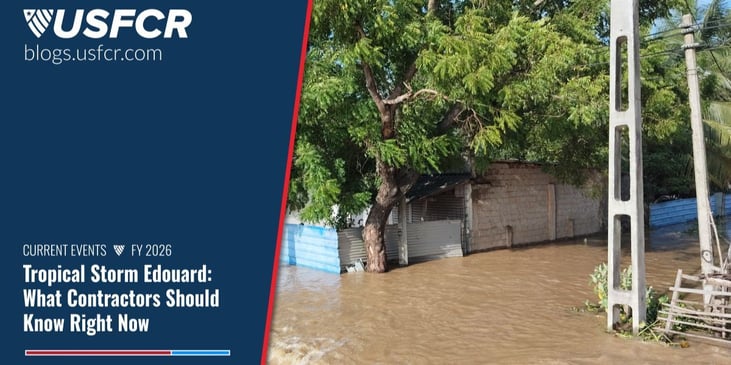
Edouard came ashore near Johnson Bayou, Louisiana, at 2:20 p.m. CDT on September 1, with maximum sustained winds of 60 mph. Port Arthur, Texas, recorded a wind gust of 90 mph along with two other hurricane-force gusts, a sharper wind impact than earlier forecasts had suggested for what was expected to be a mostly rain-driven storm. The storm has since weakened to a tropical depression, last tracked near Huntsville, Texas, and moving north-northwest at only 5 mph. The National Hurricane Center has issued its final advisory on the system; the Weather Prediction Center is now handling updates because the remaining threat is inland flooding, not tropical cyclone conditions. A flood watch remains in effect for southeast Texas, including the Houston area, through Wednesday evening, with more than 70,000 customers left without power in the Beaumont-to-Woodlands corridor.
For contractors, this timeline matters because disaster contracting opportunities do not appear all at once. They open in stages tied to the level of government response, and that response is still unfolding.
Local Emergency Declarations Are Already Active
Jefferson County and the City of Port Arthur issued disaster declarations on September 1, and Beaumont's mayor signed a preemptive declaration that same day, with a corresponding county-level filing. These local declarations are significant because they typically suspend normal purchasing and bidding requirements, letting counties and cities move quickly on emergency work such as debris clearance, road repair, and utility restoration. This is usually the first point where contracting activity actually starts, well before any state or federal opportunity is posted. Texas has already listed Tropical Storm Edouard on its active statewide disaster declarations, which activates state emergency response and recovery coordination. Louisiana has not issued an Edouard-specific state of emergency as of this writing, even though Cameron and Calcasieu parishes sat inside the storm's warning area. That is consistent with how Louisiana handled Tropical Storm Arthur earlier this year, where the state declaration came several days after the storm once damage was assessed rather than before landfall.
How the Federal Disaster Contracting Process Works From Here
No federal disaster declaration has been issued for Edouard. That step typically follows a specific sequence: local damage reporting feeds into a state disaster declaration, the governor requests a joint preliminary damage assessment, and if the damage supports it, the governor formally requests an official federal disaster declaration. Only after that declaration is in place do broader federal contracting mechanisms become available to state and local governments, including GSA's Disaster Purchasing Program, which lets eligible agencies buy disaster recovery products and services off GSA Schedule contracts.
Separately, the U.S. Army Corps of Engineers maintains pre-awarded contract vehicles under its Advanced Contracting Initiative for missions like debris removal, temporary emergency power, and temporary roofing, so it can mobilize contractors quickly once a federal response is authorized. These are typically Indefinite Delivery, Indefinite Quantity contracts awarded well in advance of any specific storm, then activated through task orders when needed. Because Edouard was a compact, moderate-strength storm whose worst effects were flooding rather than wind damage, a large federal declaration is not guaranteed. Much depends on what the damage assessments in the coming days actually show.
What Contractors Should Have Ready Right Now
The contractors best positioned to compete for disaster work are the ones who did the paperwork before the storm, not after. An active SAM registration, not one still processing, is the baseline requirement for any federal disaster contract. Beyond that, confirm your registration lists relevant disaster-response NAICS codes, such as 562119 for debris collection, 561730 for tree and vegetative debris removal, 562910 for remediation services, and 238160 for roofing. Completing a profile in the SAM Disaster Response Registry lets contracting officers find your business by capability and location. On the state side, Texas contractors should be on the Centralized Master Bidders List through Texas SmartBuy to receive automatic notifications on the Electronic State Business Daily, and Louisiana contractors should register in the LaGov Supplier Portal to receive LaPAC bid notices. Local county and parish procurement offices in the affected area are also worth monitoring directly, since that is where the earliest post-storm work is often let.

FAQ
Is there a federal disaster declaration for Tropical Storm Edouard?
Not as of this writing. Texas has an active state disaster declaration covering Edouard, and several local governments in the affected area have their own declarations, but the federal declaration process depends on damage assessments that typically take days to complete.
Where do disaster recovery contracts actually get posted?
Immediately after a storm, most opportunities come from local counties, cities, and parishes rather than a single federal listing. If a federal declaration follows, additional opportunities can appear through SAM, GSA Disaster Purchasing, and U.S. Army Corps of Engineers task orders under existing IDIQ vehicles.
What if my SAM registration is still processing?
An in-process registration will not let a contracting officer award you a federal contract. If your registration is not active, treat getting it activated as the first priority, since new registrations can take several weeks to process.
Do I need a special certification to do disaster recovery work?
Not universally. What you typically need are the standard licenses and insurance for the type of work involved, such as roofing or hauling, plus bonding sufficient to take on the job, and in some cases a local business presence that qualifies for area preference under federal emergency procurement rules.
Will more federal opportunities open up if the storm is upgraded to a bigger disaster?
Yes. A larger confirmed damage total increases the likelihood of a federal disaster declaration, which is what unlocks GSA Disaster Purchasing for state and local buyers and broader task-order activity under Corps of Engineers contract vehicles.
Next Steps
Confirm your SAM registration is active, not pending, and that it lists the NAICS codes that match the disaster recovery work you can perform. Register or update your profile in the SAM Disaster Response Registry, and if you operate in Texas or Louisiana, make sure you are on the Centralized Master Bidders List and in the LaGov Supplier Portal so state and local bid notices reach you directly. If you want help tracking opportunities as they open, USFCR Advantage can support your search for federal and SLED contract opportunities as this response develops.

