


USFCR Blog

Federal Work Slowed Down. Here's When It Picks Back Up.

Apr 3, 2026, 10:15:50 AM / by Mike Goetz posted in News, cmmc

If your federal contracting pipeline has been quiet since October, you are not doing anything wrong. The slowdown is real, it is systemic, and it has a specific cause. More importantly, it is ending.
Read More

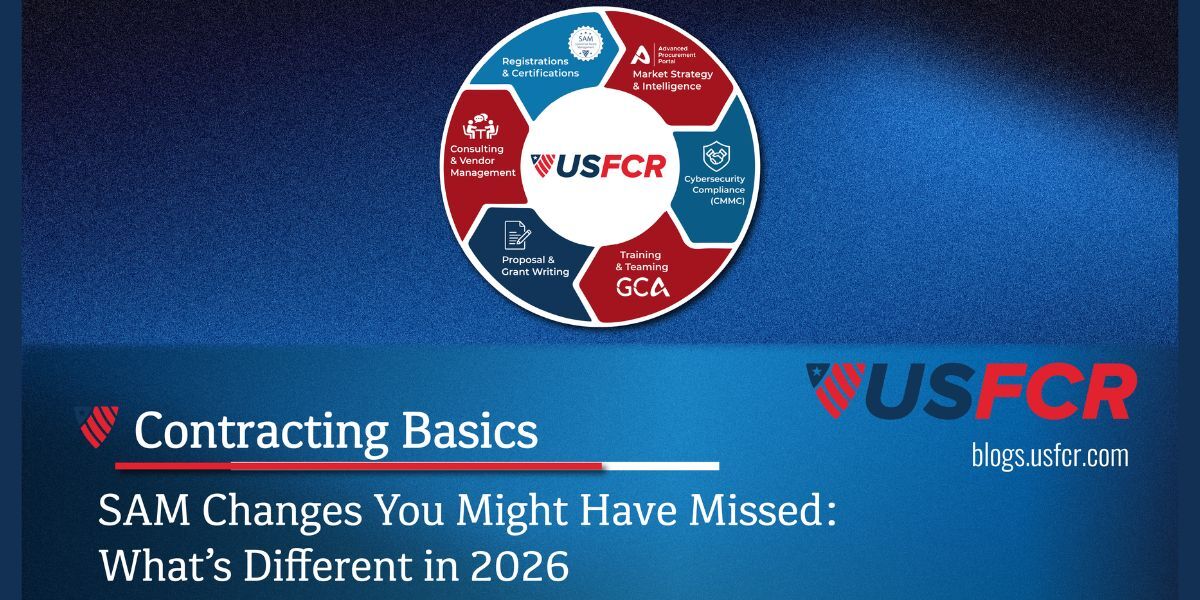
SAM Changes You Might Have Missed: What’s Different in 2026

Mar 26, 2026, 10:29:59 AM / by Kyle Hayes posted in Guides, News, Registration & Compliance Management

Quick Answer

SAM.gov went through its biggest consolidation in years between mid-2025 and mid-2026. The entity registration screens were reorganized, eSRS.gov and FPDS.gov's public search were retired and folded into SAM.gov, and a modernized reps and certs process launched. CPARS is expected to follow later this fiscal year, though no date has been set. An active registration doesn't protect a business from being caught off guard by any of this. The practical move is to check SAM.gov more than once a year.


Read More

Spring Construction Season: Federal Infrastructure Opportunities Are Here

Mar 24, 2026, 10:30:01 AM / by Kyle Hayes posted in Simplified Acquisition Program (SAP), Guides, News, Industry-Specific Contracting, Subcontracting & Teaming

Read More

Setting Q2 and Q3 Goals: What Realistic Success Looks Like

Mar 17, 2026, 10:29:59 AM / by Kyle Hayes posted in Guides, News, Registration & Compliance Management

Read More

Subcontracting Requirements: What’s Different in 2026

Mar 12, 2026, 10:30:00 AM / by Kyle Hayes posted in News, Federal Spending, Subcontracting & Teaming

Read More

Security Clearance Levels Explained: How to Get Cleared in 2026

Mar 2, 2026, 9:00:00 AM / by USFCR posted in News

What Is a Security Clearance?

A security clearance is required for individuals working with classified information in federal agencies, defense contracting, or intelligence-related positions. Whether you're a government contractor, military personnel, or federal employee, holding a clearance confirms you can be trusted with sensitive data.

Clearances are granted after a comprehensive background investigation, including a criminal history review, financial background check, and foreign contact screening. Agencies such as the Defense Counterintelligence and Security Agency (DCSA) handle investigations to protect national security.

Failure to comply with clearance requirements can lead to revocation, job loss, fines, or even imprisonment. Understanding the clearance process—and how to maintain eligibility—can help you secure long-term federal contracting opportunities.

Read More

How GSA Schedule Pricing Changed: What You Need to Know for 2026

Feb 26, 2026, 10:30:00 AM / by Kyle Hayes posted in General Services Administration (GSA), Guides, News, Federal Spending

Read More

SAM.gov Just Absorbed Two More Federal Systems: What Contractors Need to Know

Feb 25, 2026, 10:05:24 AM / by Mike Goetz posted in News, Registration & Compliance Management

If you tried to log into eSRS.gov in the last few days, you already know something changed. The site is gone. And if you use FPDS.gov to research federal contract data, that's shutting down tomorrow.

Read More

Changes to the 8(a) Business Development Program in 2026

Feb 24, 2026, 10:30:00 AM / by Kyle Hayes posted in Guides, News, Set-asides

Read More

The FAR Is Being Rewritten: What Small Business Contractors Need to Know Before June 2026

Feb 20, 2026, 8:00:00 AM / by USFCR posted in News

If you hold a federal contract or you're planning to bid on one this year, the rules you learned are changing underneath you. Not eventually. Not theoretically. Right now.

The federal government is in the middle of something called the Revolutionary FAR Overhaul. That's the official name. The Federal Acquisition Regulation, the rulebook that governs how the government buys everything, is being rewritten from the ground up. The first wave of changes already took effect on February 1, 2026. More are rolling out every few weeks. And the biggest shifts hit by June 30.

This isn't a minor policy tweak. It's the most significant rewrite of federal buying rules in decades. For small businesses, some of these changes are genuinely good news. Others require immediate attention.

Read More